AI has been quite the hot topic socially and politically in the United States as of late, and as a future educator I have rustled with the morals, ethics, and practicality of AI more times than I’d probably like. I don’t love how I feel it’s making students (at least in the cases I’ve seen) less inclined to be motivated to do their own work and when they go to do work on their own there’s clear indications that their lacking some critical thinking, reading, and writing skills. But, I would be lying if I say I haven’t ever used AI, and I don’t want to be a hypocrite. What kind of teacher would I be if I used AI and told my students that under no circumstance should they use it? As much as I don’t love AI and know that there are some serious flaws about the program, I fear I have to accept that it’s not going anywhere anytime soon, so I was excited to see on the syllabus that we were doing an assignment to test the skills of AI. I’ve had to read “student” work that was submitted but flagged for AI, so let’s see what I can learn from testing my knowledge with Microsoft Copilot:
Can Copilot Write an A+ History Paper?
I chose Copilot for the essay and photo prompt experiment because it’s the program I’m most familiar with and have been recommended by many, many people on campus. Unfortunately, I know people who have submitted work heavily or entirely relying on Copilot, so I’m curious to see how convincing it is as being a student’s voice.
The original prompt I gave Copilot was “Can you write a 3-4 page paper for an 11th grade history class about what happened in the American South during the Reconstruction era from 1865-1877?” (Here you can find the essay Copilot gave me: Copilot Essay 1)
Honestly, I feel like the way this essay reads is like a very polished 11th grade student. I didn’t feel like it was trying to give in depth explanations or give super refined writing like you’d expect from a college level student, I felt like I could be reading a paper by a high schooler. However, with the knowledge I have of high schools, there’s no way there wouldn’t have been one spelling error or completely correct uses of capitalization – you’d be surprised how many student assignments I’ve read where they didn’t even capitalize “I.” Based on this essay, I would expect this level of grammatical and/or content correctness from some of my more advanced students, but I would say the average 11th grader doesn’t right this correct.
Even after generating this paper, Copilot asked if I wanted it to “shape this into a thesis-driven essay, add citations, or adjust the tone to match [my] writing style.” So, out of curiosity, I asked it to “[make] the voice sound a little more human, create a thesis, and provide five citations.” Here you can view the second essay: Copilot Essay 2.
Again, I feel like the level of writing (and by this I mean it doesn’t go too far into explanations and the transitions are very simple) is what I’d maybe expect or wouldn’t be surprised to get from an advanced 11th grade student, but you can’t tell me most 11th graders know how to correctly use quotations, colons, and hyphens! Let alone correctly format Chicago style citations on their own, or at least get pretty close. The citations Copilot gave me I did quick searches on and 1, 2, and 4 all came up quickly on Google, but 3 and 5 did not. They are from legitimate sites like the US National Archives and the Library of Congress, but I’m not exactly sure where specifically in those sites they’re getting those sources, or at least I couldn’t find that information from quick searches on their websites. Overall, I believe that if I received a paper completely written by Copilot I’d clock it, but from experience I’ve noticed it’s super obvious when they use it in only a few places in their essay – the writing style completely changes – so if you’re my future student reading this I hope your takeaway is this: don’t even try it.
Image Creation
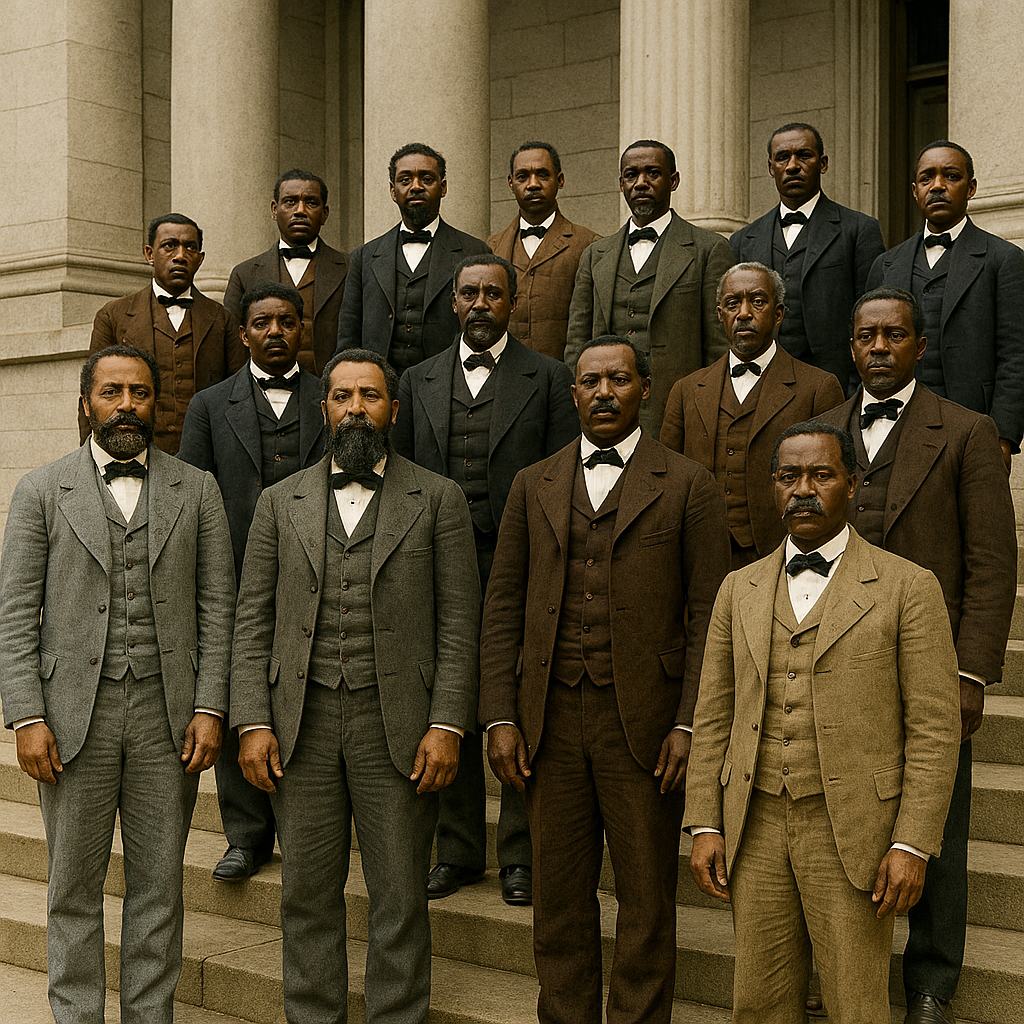
To go along with the essay, I asked Copilot to “[create] a realistic looking image that would go along with one of the topics discussed in the essay,” and this is what I got. The photo is of fifteen Black men standing on steps of what appears to be a government building with columns behind them, so I inferred Copilot was going for the concept of Black men being able to hold office, but to confirm I asked “what is this a picture of,” and “can you create a caption?” Here is the caption it gave me:
“African American legislators stand united on the steps of a Southern statehouse during Reconstruction, 1870s: Their presence marks a brief but powerful era of Black political leadership and interracial democracy in the post-Civil War South.”
Right off the bat, this image is obviously AI, it just has that AI look to it (iykyk). It just looks so fake, and after zooming in their faces just look wonky, especially their eyes, and blurred or smushed. Also, color photography was no where near (from my understanding) this advanced in the 1870s, so this is in no way realistic like I asked. So Copilot, you failed me in this department!
So I Guess We Don’t Need to Learn Cursive After All?
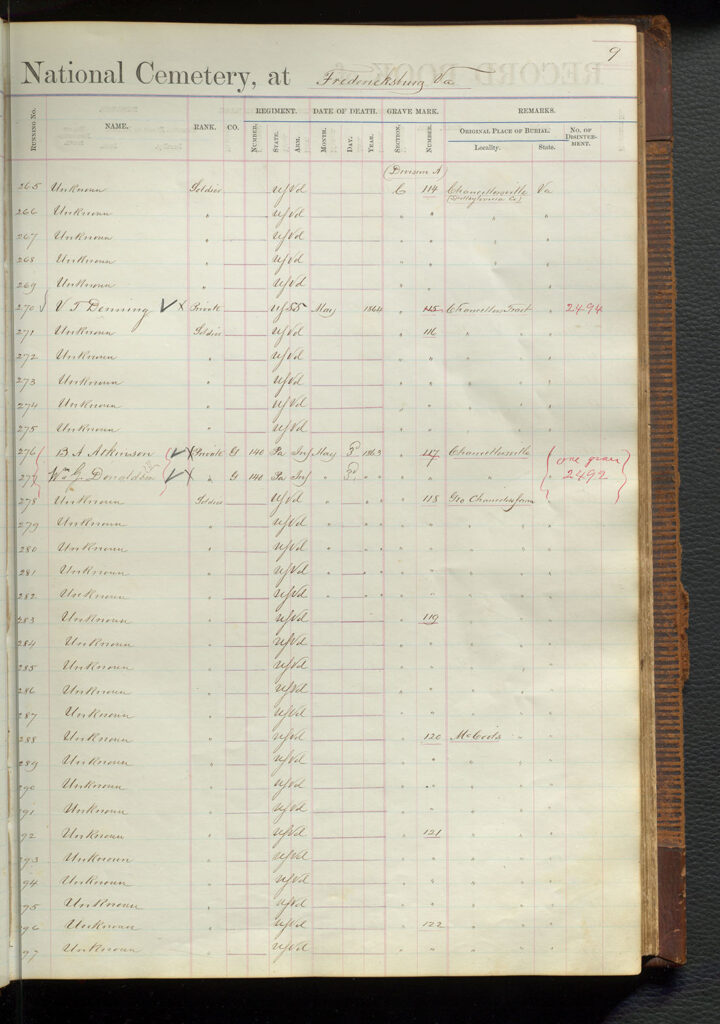
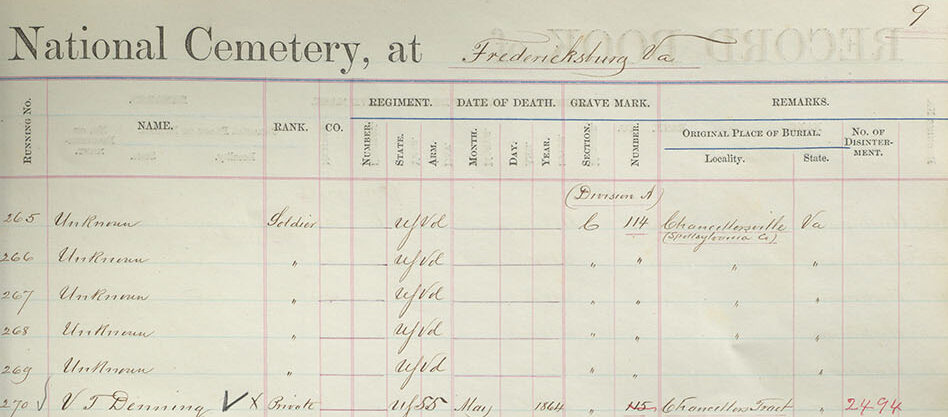
Last stop on our AI adventure is Google Gemini where I uploaded page 9 from the Fredericksburg National Cemetery Register and prompted it to “transcribe the handwriting on this image.” I was honestly very impressed by how quickly and accurately Gemini was able to do this! (View the transcription here: Page 9 Transcription). I have briefly used Gemini in the past, but when I heard in class that it could transcribe handwriting my attention was caught because from my understanding, reading through documents with hard to read handwriting and having to transcribe them is on of the most tedious and time consuming processes in creating digital history projects. Of course these things should be proof read by a human before uploaded to a public platform, but how much time could we save and how many more documents can we make accessible by using programs like this! AI has its drawbacks, but examples like these give me at least a glimmer of hope that AI can be used to make documents and resources that were so inaccessible before accessible and appreciated.
Generative AI: A Blessing and a Curse
Overall, the optimist in me wants to believe that AI will be used for good, productive purposes like handwriting transcription because that is a clear example of it being what it’s meant to be: a tool.
My problem with using AI for writing essays or generating images is that it can quickly be misused or used as a crutch, and my fear is that the younger generation is going to lack some of the critical thinking skills, reading skills, or writing skills that I argue are fundamental to being a well informed member of society. Additionally, especially in terms of the image and video creation, we’re starting to see AI quickly become pretty realistic, or at least realistic enough for my friends to be telling me that their parents send them cute videos of birds hugging thinking it’s real when it was generated by programs like ChatGPT. I can’t say I’m all on board, but I can say I have hope that as we learn more about AI and its consequences that the next generations won’t be so inclined to be relying on AI to get them out of things like writing a coherent paragraph (I hope).